Materials & Man/Material Hoist Hire Adelaide
Materials & Man/Material Hoist Hire Adelaide
Alimak hoists for multi-storey Adelaide builds. Typical 2-tonne man/material cages, engineered into your scaffold from day one. Dry hire or operator arranged.
Recent work in Adelaide
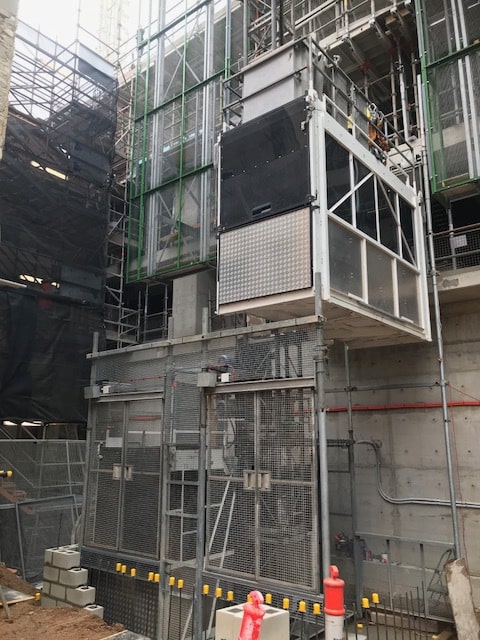


Materials & Man/Material Hoist Hire in Adelaide
Vertical materials and personnel transport for multi-storey commercial builds, apartment towers and infrastructure. Epic owns Alimak hoists, typically 2-tonne man/material cages, engineered into your scaffold from day one. No separate mobilisation, no double handling, no crane hours burning through your budget.
Get a hoist quote or call Epic on 0410 486 750.
When a hoist beats a crane
The rule of thumb is simple. Below four storeys or fifteen metres, a crane usually wins on cost and flexibility. Above that, especially where daily material movement is heavy over months rather than weeks, a hoist becomes cheaper, safer and faster.
A hoist is the right call when:
- You are running a build of four storeys or more with sustained material flow
- Crane hours are the constraint, or a second crane cannot be justified
- Loads are contained inside the cage rather than being craned over live site personnel
- Programme certainty matters more than one-off flexibility
- Mechanical services or fit-out crews need reliable vertical access at all hours
A crane is still the right call for very heavy single lifts, occasional movement, or short-programme jobs where hoist mobilisation cannot amortise across the duration.
Hoist vs crane vs stairs: how to choose
Most head contractor PMs run the same evaluation on every multi-storey job. This table sets the framework so the site visit can move straight to specifics.
| Factor | Materials hoist | Tower crane | Stairs / lift |
| Best for | 4+ storeys, sustained vertical material flow over months | Heavy single lifts, structural steel, precast, short programmes | Below 3 storeys, light-touch fit-out, occupied buildings without power |
| Programme certainty | High. Runs on demand, weather-tolerant inside the cage | Medium. Weather stand-down, competing lift requests | Low. Bottlenecks trade productivity above ground floor |
| Safety exposure | Contained inside cage, no over-personnel loads | Slung loads over live site require exclusion zones | Manual handling injuries, trip/fall on stairs, tight lifts with debris |
| Compliance overhead | HRWL operator (HM or HP), monthly inspection, Certificate of Compliance | Crane operator ticket, rigger, dogger, lift study per lift | Manual handling assessments, SWMS per trade |
| Break-even (rule of thumb) | Wins above ~4 storeys with daily material movement over 4+ weeks | Wins for heavy lifts or programmes under 6 weeks | Wins on jobs under 3 storeys with light material flow |
The break-even is not universal. Debris volume (chute-heavy demolitions), trade count (personnel movement changes the maths), and site power availability all shift the answer. The site visit prices the specific job.
Hoist types Epic delivers
Epic owns Alimak hoists and holds access to additional hoists interstate where a specific job needs it. The typical Adelaide hoist we deliver is a 2-tonne man/material cage. A second 2-tonne materials hoist is being installed next month.
Cage hoists (goods only). Modular cages, engineered load class per project, running off site power as standard. Right choice for multi-storey apartment builds where the movement is mostly materials.
Man/material hoists (personnel plus goods). Cage plus personnel-rated hoist with the operator ticketing and safety systems that come with certified personnel movement. Our default 2-tonne cage. Right choice on major apartment or office builds where the crew is heavy on the tools every day and running personnel up the stairs kills productivity.
Mast climbers. Sustained facade work (painting, cladding, waterproofing) where the working face is the outside of the building and the crew stays on the deck for months. Mast climber outperforms a swing stage where the duration is longer than four weeks or the load per lift is above what a swing stage can safely carry.
Craneable lifts. Modular lifts designed to be crane-repositioned between phases of a job. Right choice on programmes where the scaffold reconfigures every few weeks and the hoist needs to move with it.
Mast climber vs swing stage: decision matrix
For sustained facade work the question is rarely hoist-vs-nothing. It is mast climber vs swing stage. This is how we frame the call.
| Factor | Mast climber | Swing stage |
| Programme duration | 4+ weeks continuous | Under 4 weeks, or intermittent access |
| Load per lift | Higher (heavy cladding panels, waterproof membrane rolls, tool trolleys) | Lower (hand tools, paint, light materials) |
| Working platform | Full deck, crew stays on the deck all day | Suspended platform, more restricted |
| Trade suitability | Cladders, waterproofers, painters on long programmes | Window cleaners, spot painters, glazing repair |
| Weather tolerance | Higher (mast-mounted, more stable) | Lower (wind-sensitive above certain thresholds) |
| Load path required | Mast tie-in back to scaffold or building | Roof anchors, counterweight system |
| When to specify each | Facade re-clads, sustained painting, waterproofing programmes over one month | Short facade touch-ups, spot access, jobs where mast tie-in is not viable |
The break-even is typically around the four-week mark on a facade of one elevation. Multi-elevation programmes almost always favour the mast climber for the load and duration reasons above.
Hoist specifications
| Spec | Value |
| Minimum height a hoist is cost-effective | Approximately four storeys or 15m |
| Typical cage | 2-tonne man/material hoist |
| Brand | Alimak, with access to additional hoists interstate |
| Power | Site power (single phase or three phase depending on hoist type) |
| Operator | Dry hire standard, operator can be arranged |
| Operator ticket required | High Risk Work Licence, class per hoist type (HM materials, HP personnel + materials) |
| Day-one scaffold integration | Engineered into scaffold drawings before mobilisation |
| Spares | Common spares held locally, other parts via Melbourne |
| Mobilisation | Depends on machine availability. Hoists are usually planned well ahead in the programme. |
| Certification | Certificate of Compliance at install, monthly inspection reports |
| Standards conformance | AS/NZS 1576 (scaffolding tie-in), manufacturer engineering per hoist type |
Site prep checklist
To hit the mobilisation SLA the head contractor needs the following in place before Epic arrives. We flag missing items at the site visit so nothing surprises the programme.
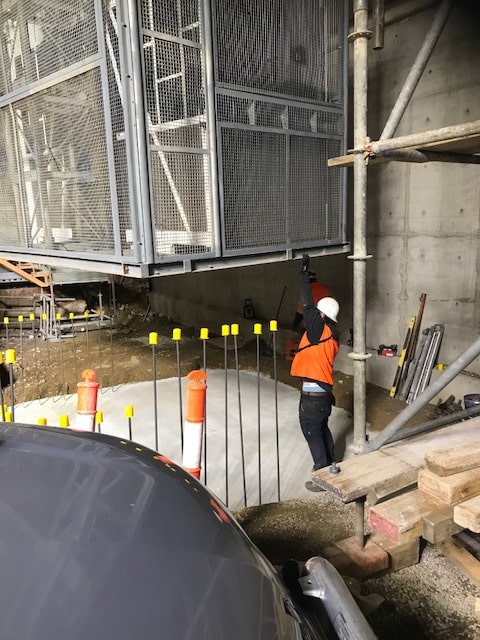
- Ground base pad. Level, compacted, with the reaction load capacity noted on the hoist engineering drawing. Concrete slab or engineered fill is the norm.
- Power tail. Single phase or three phase to the base of the hoist depending on hoist type. Cable run and switchboard capacity confirmed by the site electrician. Epic runs off site power.
- Tie-in points on scaffold. Engineered from day one if Epic runs both scaffold and hoist. If the scaffold is already up under another vendor, Epic reviews and specifies retrofit tie-in points.
- Clearance zones. Vertical clearance for the mast height, lateral clearance for the cage swing and loading platforms at each level, no overhead services in the exclusion zone.
- Loading platforms. Landing platforms at each level requiring material transfer, ideally engineered into the scaffold before hoist install.
- Site amenities. Operator access to site facilities, secure storage for the control panel and spare parts, exclusion signage at ground level.
- Interface with tower crane (if applicable). Sequenced install so the tower crane can position mast sections, then hoist runs autonomously.
Day-one scaffold integration
Most hoist installations we see on other Adelaide sites are bolted on to the scaffold as an afterthought. That means a separate mobilisation, a separate crane call, a separate certifying engineer, and a scaffold that has to be modified to receive the hoist after it is already up.
We do not do it that way. When we quote a multi-storey job that will need a hoist, the hoist tie-in points are engineered into the scaffold drawings from day one. That means one design, one Certificate of Compliance workflow, one team on site, and no rework when the hoist arrives.
The saving on a twelve-storey apartment build is typically two to three weeks of programme and one full crane call.
What a hoist engagement looks like
- Site visit. Bryan or Reuben walks the site with your PM. We identify the scaffold interface, the ground-level base, power supply, and the working programme.
- Engineered drawings. Hoist tie-in and load path returned with the scaffold drawings before mobilisation. Designs certified by DC Engineering (CPEng), who hold PI cover on the design.
- Install and commissioning. Hoist installed and load-tested. Certificate of Compliance issued at hand-over.
- Monthly inspection. Documented inspection cadence for the duration of hire.
- Reconfigure or dismantle. As the programme progresses, we lift, extend or dismantle the hoist to suit.
Prequalification and insurance
Answers to the questions your procurement and WHS teams ask before shortlisting a hoist vendor.
- WorkCover Employer: 28107911
- Public and Products Liability: $20M, insurer Sompo Japan Insurance via SURA Liability
- Engineering: designs certified by DC Engineering (CPEng), Professional Indemnity cover held on the design
- Government work: Epic works for head contractors delivering DIT SA projects and has recently been awarded an SA Water contract. Not OFSC accredited.
- Crew: 2 to 20 depending on the job. Tickets from labourer through to SA-licensed riggers. Working at heights, EWP and confined space tickets typical. Crew hold DCAC cards and SA Water blue cards.
- Standards conformance: AS/NZS 1576 (scaffolding tie-in), manufacturer engineering per hoist type, Certificate of Compliance at install
- Inspection cadence: monthly documented inspections for the duration of hire
- SWMS: issued per mobilisation, JSA on request
- Compliance pack: full pack available for tender submission (insurance certificates, prequalification statements, HRWL register, sample SWMS, engineering credentials)
Named project
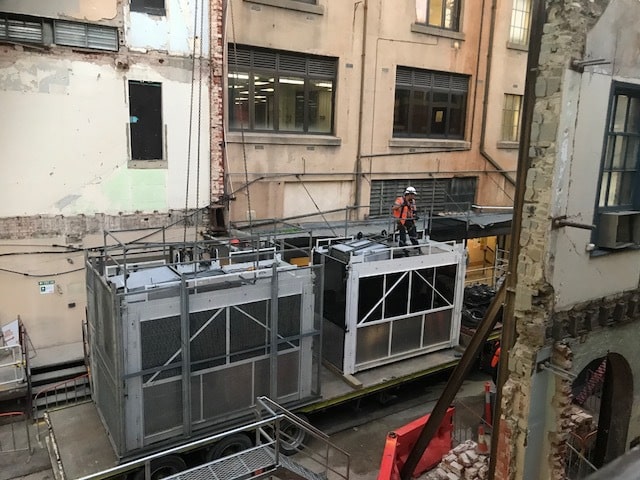
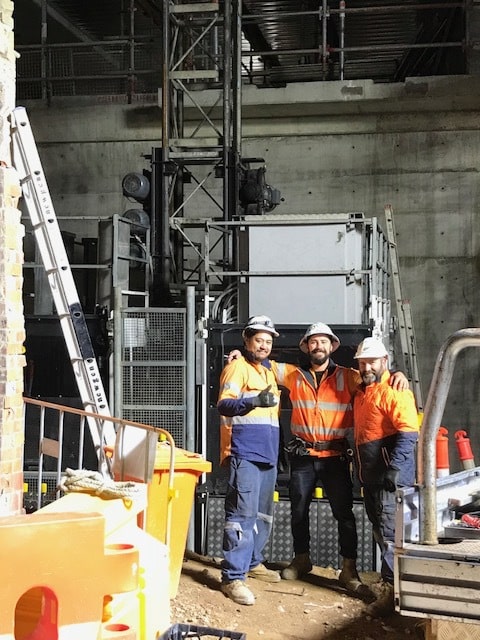
- Adelaide GPO Exchange. Epic ran a multi-storey hoist install as part of the works programme, engineered into the scaffold from day one.
Case study: Adelaide GPO Exchange, materials hoist install
The job: sustained vertical material movement on the Adelaide GPO Exchange multi-storey works programme. The site was tight, the tower crane was constrained, and running fit-out materials up the stairs would have burned days across the programme, so the hoist had to be planned into the scaffold from the start rather than bolted on late as an afterthought.
The engineered solution. Epic engineered the tie-in points for a 2-tonne Alimak materials hoist into the scaffold drawings before mobilisation. Load transferred back through the Proscaf ringlock structure to the ground-level base rather than needing independent bracing, landing platforms were engineered into the scaffold at each level requiring material transfer, and Certificate of Compliance ran across both the scaffold and the hoist as one design.
Engineered by DC Engineering (CPEng), with the design set to AS/NZS 1576 and AS/NZS 4576. Dry hire with an HRWL-ticketed operator running the cage, and monthly documented inspection reports logged for the duration of hire. The saving on a multi-storey programme like this typically runs to two to three weeks of programme time versus a scaffold-then-hoist retrofit.
Frequently asked questions
Does Epic supply the operator or is it dry hire?
What HRWL classes does Epic require of hoist operators?
How high can a hoist go?
What power do we need on site?
Can Epic quote hoist and scaffold together?
How long does hoist mobilisation take?
Is a mast climber or a swing stage better for facade work?
Is the hoist covered under Epic’s Public Liability insurance or a separate policy?
What about spare parts and breakdown response?
Can you provide a full compliance pack for our tender submission?
What certification hand-over do we get at install?
What compliance and certification does Epic hold?
Ready to price this in Adelaide?
Send us the details and we’ll book a site visit inside 48 hours.